


What’s the Best Way to Sell My Property in Melbourne?


If your Google search history is just versions of “How to sell my property?”, then you are at the right place. This guide walks through all your options in Victoria’s market, from auction, private treaty, EOI, to off-market, along with the steps, legal requirements, and real costs involved, so you can decide what’s right for your situation.
Key Takeaways
- Auctions suit high-demand suburbs and maximise competition.
- Private treaty gives more control in cooler markets.
- Total selling costs typically add up to 3–5% of the sale price (commission + marketing + conveyancing + other fees).
- Section 32 requires the Vendor Statement and Contract of Sale to be prepared before marketing.
- List on both realestate.com.au and Domain.com.au for maximum buyer reach.
What Are the Main Ways to Sell a Property in Melbourne?
Generally, Melbourne sellers have four sale methods and two ways of running the sale (through an agent or on their own) to choose from. This depends on the type of property you have, the suburb you’re in and whether you want speed, privacy or price.
Real Estate Agent vs Private Sales (FSBO)
A real estate agent handles pricing strategy, marketing, buyer negotiations, and all the paperwork, whereas with an FSBO (For Sale By Owner), you handle all that work yourself.
FSBO helps you save the commission, but you are the one who has to price accurately, deal with enquiries and negotiate without an agent’s market data or leverage.
| Factor | Real Estate Agent | Private Sale (FSBO) |
| Who handles it | Agency | Owner |
| Suited methods | Auction, Private Treaty, EOI, Off-Market | Private Treaty / Fixed Price |
| Trade-off | Commission + marketing cost; higher reach and negotiation pressure | Saves commission; requires personal time, DIY marketing, negotiation skill |
Auction, Private Treaty, EOI & Off-Market: Which Sale Method Suits You?
There are four main sales methods; that depends on the property type, suburb, and market conditions. Understanding how they work helps you choose the right approach for your goals.
| Method | How It Works | Best For |
| Auction | 3–4 week campaign, live public sale on a set date; highest bidder wins. No cooling-off or finance clause. | Family homes in high-demand suburbs, renovated/turn-key properties. |
| Private Sale (Private Treaty) | Fixed price or guide-range ad; buyer negotiates directly or through an agent. | Outer suburbs, units/apartments, softer markets, flexible timing. |
| Expression of Interest (EOI) | Buyers submit their best written offer by a set deadline; offers stay confidential. | Prestige homes, unique properties, land where value is hard to fix. |
| Off-Market Sale | Never publicly listed; agent privately matches it to pre-qualified buyers in their network. | Tenanted properties, privacy, testing price without advertising cost. |
What Steps Are Involved in Selling a House?

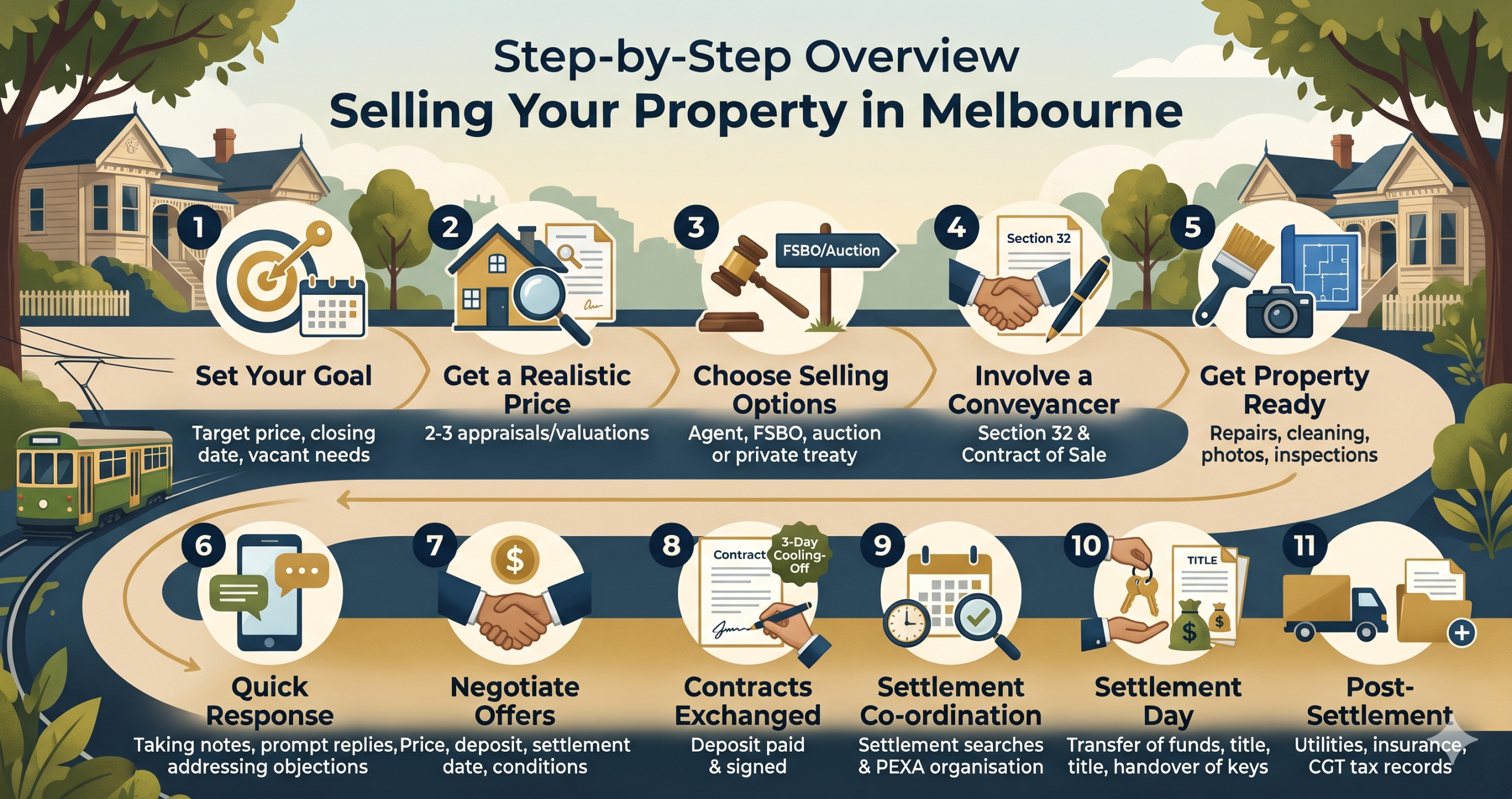
Step-by-Step Overview
- Set your goal: Target price, closing date, vacant possession needs; check your mortgage payout figure.
- Get a realistic price: 2-3 appraisals or an independent valuation checked against comparables sold in the last 3-6 months.
- Choose the selling options: Agent, FSBO, auction or private treaty that are appropriate to the property type and suburb.
- Involve a conveyancer early: Have your Section 32 and Contract of Sale ready before you start marketing.
- Get property ready: Repairs, cleaning, professional photos, floor plans/video, pre-sale building/pest inspections.
- Quick response: Take notes from client input and address queries promptly. Change price if objections continue.
- Negotiate offers: Price, deposit, settlement date and conditions; Set a realistic reserve price based on interest before sale.
- Contracts exchanged: Deposit paid & signed by the buyer. 3-day cooling-off period to private treaty buyers.
- Settlement co-ordination: Including arranged searches by the settlement agent, PEXA organisation and confirmation of time with all parties.
- Settlement day: Transfer of funds through PEXA, registration of title and handover of keys and fixtures.
- Post-settlement: Utilities, insurances, council rates, post-settlement, cancel/transfer. Retain all documents for Capital Gains Tax purposes.
What Legal Documents Do I Need to Prepare Before Selling?
- Section 32 Vendor Statement: Disclosure on title, rates, water, land tax, zoning, overlays, notices, owners corporation.
Upcoming 14‑day rule (proposed): The Consumer Legislation Amendment Bill 2026 passed the Victorian Legislative Assembly on 30 July 2026 and is before the Legislative Council. If enacted, it would require the Section 32 Vendor Statement to be available at least 14 days before an auction/fixed‑date sale, or before a contract is signed in a private sale. Check with your conveyancer whether it applies when you sell.
- Contract of Sale: price, deposit, settlement date, special conditions, inclusions.
- Verification of Identity (VOI): it is required for PEXA electronic settlement.
- Title Search/Certificate of Title: an official record of the property’s owner, and if any easements, covenants or encumbrances are registered against it.
- Conveyancer: not a legal requirement but is recommended. Mistakes in Section 32 or the contract can result in delays, penalties or failed settlement.
How to Sell My Property Fast in Melbourne?
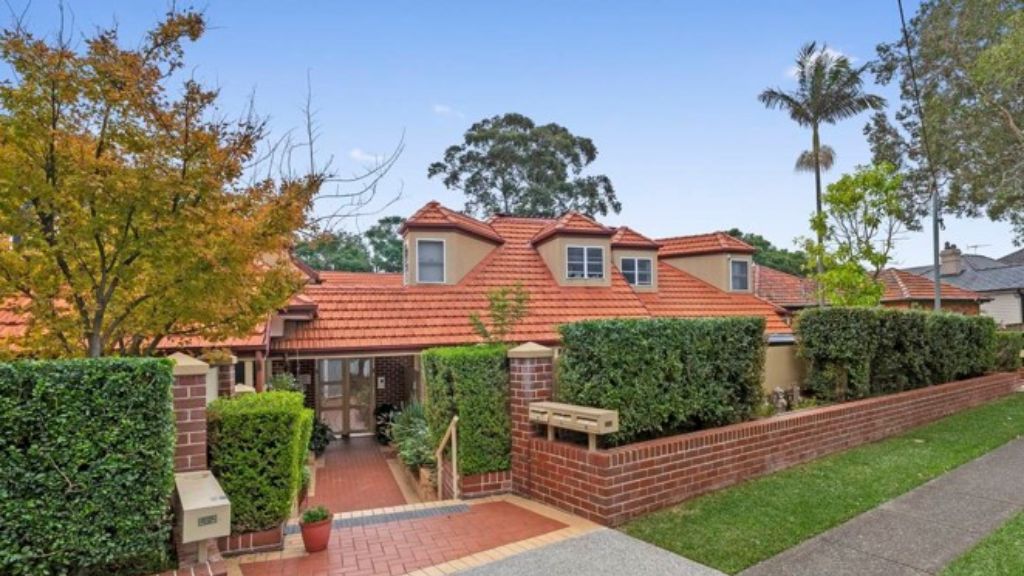
Properties in Melbourne’s inner suburbs generally sell faster than those in the middle and outer rings, although rising stock levels and softer buyer demand are beginning to push days on market.
According to Real Estate Institute of Victoria (REIV) data, the median days to private sale have increased to 46 days in July 2026 from 43 days in June and 37 days in July 2025.
Pricing Strategies, Cash Buyers, and Off-Market Sales
Strategy:
- Pricing must be within 2-3% of recent comparable sales. The number one reason properties don’t sell is always overpricing.
- Target cash or unconditional buyers for a faster, more certain close (often under 4 weeks without finance conditions). These buyers may seek a discount for speed and certainty; in some cases offers can be 10–20%+ below typical financed offers, but many cash buyers will pay close to market if the property is well priced and presented.
- Off-market campaigns reach fewer buyers but offer privacy and lower marketing cost – a direct trade-off against sale price.
- Get building/pest reports upfront to remove a common buyer condition and reduce the risk of late renegotiation (Owner Inspections, Informed Building Inspections).
- Run 2-3 open homes in the first 10 days and stay flexible on settlement date.
What Is the Best Platform to Sell Property Online in Melbourne?
| Option | Cost (2026) | Trade-off |
| Agent listing | Commissionaverage ~2.0–2.1% + $6k–$8k advertising | Full campaign management, higher cost |
| DIY fixed-fee platform | $500–$2,499 one-off, no commission | You manage all enquiries and negotiation |
| Flat‑fee / low‑commission platform (e.g. Unreserved) | From ~$900 flat fee (no commission); premium packages ~$6,900 | You manage most of the sale, with AI tools and optional agent support depending on package. |
Agent-Only Portals vs DIY Private Listing Sites
One of the best platforms to sell property is realestate.com.au (REA Group). But you can’t advertise directly on realestate.com.au or Domain without an agent or an approved fixed-fee FSBO site.
How Much Does It Cost to Sell a Property (Commissions & Fees)?
Total selling costs typically run 3–5% of sale price, where the:
- Agent commission: 1.6%–2.5% (metro average ~2.0–2.1%)
- Vendor-paid advertising: $6,500–$8,000 for a typical Melbourne campaign
- Conveyancing/legal: $700–$2,200
- Auctioneer fee: $400–$1,000 (sometimes bundled into commission)
- Mortgage discharge: $150–$1,500
- Optional: pre-sale building/pest $400–$700, styling $1,500–$3,000
For example, on a $900,000 sale via an agent:
Commission ~$18,000 + marketing ~$7,000 + conveyancing ~$1,500 + auctioneer ~$700 + discharge ~$400 = ~$27,600 total (~3.1%). Via a fixed-fee FSBO platform: ~$3,700–$6,300 total (~0.4–0.7%), excluding negotiation leverage and time cost.
Can I Legally Sell My Property Without an Agent?
Yes. Victorian law allows private sales (FSBO).
Requirements:
- A Section 32 Vendor Statement given to buyers before signing.
- A legally sound Contract of Sale (use a conveyancer to draft/review).
- A fixed-fee FSBO platform for listing, since only agents can list directly on the major portals.
- Private treaty sales provide buyers with a statutory 3-business-day cooling-off period under Section 31 of the Sale of Land Act 1962 (Vic). Note: vendors do not receive a cooling-off period.
Key risks: Lack of market data leads to underpricing; incomplete section 32 leads to buyer rescission or delay, and enquiry management is also time-consuming.
FAQs
Can I sell my property that has tenants in it?
Yes. The tenancy remains in place, and the buyer becomes the new landlord. You have to give a 90-day Notice to Vacate for vacant possession.
What happens tax-wise if I sell my house below market value?
Selling below market value to family, a trust, or an SMSF triggers CGT based on market value, not the price paid.
Do developers pay more than market value for property?
Sometimes, when there is high redevelopment potential, offers will still be subject to feasibility, build cost and approval risk.
Do I have to pay capital gains tax when I sell my property?
Investment properties incur CGT. Before 1 July 2027, the 50% discount applies. From that date, indexation and a 30% minimum tax replace it; pre‑existing gains keep the discount.
Do I need a solicitor or conveyancer to sell my house?
Not compulsory, but strongly recommended for Section 32 preparation, contract review and PEXA settlement management.
Can I Sell My House to the Bank If I Can’t Pay My Mortgage?
You can’t just sell the house back to the bank. If repayments get tough, you can sell it yourself, work with the lender on a sale, or, if you default, the bank may sell it as a mortgagee.
Can the government buy my property directly?
Yes, Governments can acquire land for infrastructure/public purposes under Victorian law (e.g., Land Acquisition and Compensation Act 1986), paying compensation that typically includes market value and reasonable relocation/disturbance costs.